
Category: Research
Heidegger on Technology
2025-04-28의 에라스무스 독서회에 참석은 하지 못하고 그 다루는 책을 보며 몇 자료를 찾아 둔다.
This is Technology Ethics: An Introduction
- Sven Nyholm
- ISBN: 978-1-119-75557-9
- 2023-01, Wiley-Blackwell
- 288 pages
- https://www.wiley.com/en-us/This+is+Technology+Ethics%3A+An+Introduction-p-9781119755579
An approachable introduction to the philosophical study of ethical dilemmas in technology
In the Technology Age, innovations in medical, communications, and weapons technologies have given rise to many new ethical questions: Are technologies always value-neutral tools? Are human values and human prejudices sometimes embedded in technologies? Should we merge with the technologies we use? Is it ethical to use autonomous weapons systems in warfare? What should a self-driving car do if it detects an unavoidable crash? Can robots have morally relevant properties?
This is Technology Ethics: An Introduction provides an accessible overview of the sub-field of philosophy that focuses on the ethical implications of new technologies. Requiring no previous background in the subject, this reader-friendly volume explores ethical questions concerning artificial intelligence, robots, self-driving cars, brain implants, social media and communication technologies, and more. Throughout the book, clear and engaging chapters describe and discuss key discussions, issues, and themes while inviting readers to develop their own perspectives on a wide range of moral and ethical questions.
- Discusses how various technologies influence and shape individuals and society both positively and negatively
- Illustrates how emerging technologies affect traditional ideas about ethics and human self-understanding
- Addresses the ethical complications of creating technologies that may lead to morally problematic consequences
- Considers if the benefits of new technologies outweigh potential drawbacks, such as how people interact online through social media
- Explores how established moral and ethical theories relate to new questions concerning advanced technologies
Understanding Heidegger on Technology
Heidegger on Technology
- Edited By Aaron James Wendland, Christopher Merwin, Christos Hadjioannou
- ISBN 9780367586225
- 2020-06, Routledge
- 360 Pages
- https://www.routledge.com/Heidegger-on-Technology/Wendland-Merwin-Hadjioannou/p/book/9780367586225
- review by David R. Cerbone, West Virginia University
⌈자연의 개념⌋ (The Concept of Nature: Tarner Lectures Delivered in Trinity College, November, 1919)

출판사 페이지:
- https://www.sixshop.com/galmuri/product/352
- http://daziwon.com/?page_id=1434&mod=document&pageid=1&uid=10768
알프레드 노스 화이트헤드가 1919년 트리니티 칼리지에서 진행한 타너 강의록. 화이트헤드의 타너 강의의 주제는 ‘과학철학, 그리고 다양한 지식 분야 사이의 관계 또는 관계의 결핍’이다. 1920년 처음 출간되었을 때 『자연의 개념』은 향후 수년간 철학과 과학의 관계에 관한 가장 중요한 연구 중 하나가 될 것이라는 평가를 받았다. 여러 세대가 지난 지금 『자연의 개념』은 여전히 주의 깊게 읽을 가치가 있는 책이다. 화이트헤드는 실체, 공간, 시간이라는 근본적 문제들을 탐구하면서 아인슈타인의 결과 해석 방법을 비판하고, 자신의 4차원 시공간 다양체 이론을 전개한다. 『자연의 개념』을 통해 소개되는 새로운 자연관은 과학적 연구를 인도하는 많은 어휘와 개념에 새로운 빛을 비춘다.
이 책은 스티븐 샤비로의 표현대로 “화이트헤드 철학의 기본 목적이 그가 ‘자연의 이분화’라고 부르는 것의 절대적인 분열을 극복하는 데 있었다”는 것을 보여 준다. 서양 철학자들은 현상적으로 나타나는 세계(나무의 푸르름, 햇볕의 따스함 등)와 그 안에 숨겨진 물리적 실재를 구분하는 것에 익숙한데 화이트헤드는 이 분열을 완전히 없애 버리려고 한다. 화이트헤드는 자연의 다양한 요소가 어떻게 연결되어 있는지를 분석하는 것이 바로 자연철학이라고 말한다.
화이트헤드에 따르면 언제든 어디서든 무언가가 일어나고 있다면, 거기에 사건이 있다. 사건에 대한 이런 주장은 과학에서 근거를 찾기 힘든 ‘자연의 이분화’ 학설들과 달리, 시공간 전반에 걸쳐 전자기장의 놀이를 전제하는 근대 물리학에 의해 지지된다고 화이트헤드는 말한다. 화이트헤드는 사건에 대한 이러한 개념을 토대로 해서 ‘자연의 이분화’로 빠지지 않는, 자연에 대한 일관된 설명을 추구해 나간다.
- 저자: Alfred North Whitehead; 역자: 안호성
- ISBN: 9788961953764 93100
- 도서출판갈무리 카이로스총서110
- 출간: 2025-02-28
- 분량: 320쪽
https://www.gutenberg.org/files/18835/18835-h/18835-h.htm
Bayer-Microsoft collaboration for agriculture
[기사 01]의 도입부의 내용을 보고 궁금하여 [자료 01], [자료 02], [자료 03]을 확인
[기사 01] 2024-09-21
Microsoft: Wie der Tech-Konzern so mächtig wurde – und noch mächtiger wird

[자료 01] 2023-11-13
Bayer collaboration with Microsoft connects farm data to address lack of data interoperability in agriculture
New connectors allow secure, compliant data exchange / Industry platform Microsoft Azure Data Manager expands as more companies bring solutions: Leaf Agriculture further enhances useability of farm machinery data and OneSoil powers in-season detection and identification of key cash crops / Bayer experts are available from November 12-18 in hall 8, booth C15
Bayer and Microsoft have announced new data connectors that enable secure and compliant data exchange between Bayer’s digital farming platform, Climate FieldView™, and original equipment manufacturers (OEMs) via Microsoft’s Azure Data Manager for Agriculture. This collaboration aims to address the longstanding issue of data interoperability in agriculture, allowing farmers to seamlessly integrate and utilize data from various sources. By enhancing connectivity, the partnership seeks to improve decision-making processes, promote sustainable practices, and drive innovation across the agricultural value chain.
[자료 02] 2024-08-08
AI in the fields: Copilot powers smarter farming
- Microsoft is focusing on empowering around 600 million smallholder farmers globally by offering access to essential technology solutions.
- Through Azure Data Manager for Agriculture and generative AI, Microsoft aims to help farmers implement smarter, sustainable farming practices.
- The article highlights key challenges farmers face:
- Yield losses can reach up to 40% due to pests and diseases.
- Limited access to critical information and agronomic expertise, as seen in India, where agriculture employs over 43% of the workforce.
- Microsoft collaborates with partners like ITC (an Indian multi-business company) to develop Krishi Mitra (“farming friend”):
- An agricultural super app based on Microsoft’s copilot template.
- Allows farmers to ask questions in their native languages, with AI-powered responses on weather, agronomy, and other key topics.
- The app integrates natural language chat functionality with generative AI to provide tailored guidance on:
- Crop management
- Pest control
- Soil health
- Water conservation
- Microsoft’s language localization tools ensure the app serves a linguistically diverse user base, giving farmers critical farming information in their preferred languages.
- Expansion Goals:
- By the end of 2024: Reach over 100,000 farmers in India.
- By 2030: Aim for a 10 million user base, enhancing agricultural decision-making and sustainable practices.
[자료 03] 2024-04-02
Generative AI in Azure Data Manager for Agriculture
https://learn.microsoft.com/en-us/azure/data-manager-for-agri/concepts-llm-apis
Microsoft copilot templates empower organizations to build agriculture copilots. Our copilot templates enable seamless retrieval of data stored in Azure Data Manager for Agriculture so that farming-related context and insights can be queried in a conversational context.

Mitch Waldrop on The Dream Machine (2021-08)
by Luminary
Part 1: 1940s-1970s https://luminary.fm/episode/mitch-waldrop-on-the-dream-machine-part-1-1940s-to-1970s/ (2021-08-02)
This first episode touches on Mitch’s journey writing The Dream Machine and the period from the 1940s through the 1970s, which includes: The philosophy underlying hardware and software, the work of intellectual contributors such as Vannevar Bush, Von Nuemann (“Von Neumann”의 오타일 것으로 생각함), and Claude Shannon; interactive computing, the Arpanet, World war II as a catalyst for computing, timesharing, JCR Licklider’s intergalactic network, Arpa’s woodstock moment, and the Xerox Palo Alto Research Center, also known as PARC.
Part 2: 1980s-present https://luminary.fm/episode/mitch-waldrop-on-the-dream-machine-part-2-1980s-to-present/ (2021-08-16)
This second installment of our three-part series with Mitch Waldrop continues from where we left off in episode 1. We launch back into the 70s and make our way through the 80s, 90s, and up to present time. Mitch also offers some thoughts on the future and shares a bit about his recent work.
Part 3: JCR Licklider, Xerox PARC and TCP/IP https://luminary.fm/episode/mitch-waldrop-on-the-dream-machine-part-3-jcr-licklider-xerox-parc-and-tcp-ip/ (2021-08-30)
Our third and final episode with Mitch includes the story behind the intellectual forefather of the internet and interactive computing, JCR Licklider. This was the first recording we did with Mitch which covers a sprawling and wide range of topics, including: JCR Licklider’s role in the research and engineering of personal computing, Xerox PARC and the personal computing revolution, contributions from Alan Turing and Norbert Wiener, adoption of TCP/IP, and the nature of software and computing.
대한민국 모바일 신분증 진행 현황 2024-06
소개
행정안전부> 업무안내> 디지털정부혁신실> 스마트전자정부 구축> 모바일 신분증 (mois.go.kr)
모바일 신분증 https://www.mobileid.go.kr/
관계법령
전자정부법 제10조(전자정부서비스를 제공받는 자에 대한 본인 확인)
행정기관등의 장은 전자정부서비스를 제공할 때 해당 이용자 등의 신원을 확인할 필요가 있는 경우에는
「전자서명법」 제2조제2호에 따른 전자서명(서명자의 실지명의를 확인할 수 있는 것을 말한다. 이하 “전자서명”이라 한다)이나
국회규칙, 대법원규칙, 헌법재판소규칙, 중앙선거관리위원회규칙 및 대통령령으로 정하는 방법으로
그 신원을 확인할 수 있다.
개정 2020. 6. 9., 2022. 1. 11.
제목개정 2022. 1. 11.
https://www.law.go.kr/법령/전자정부법/(20230516,19030,20221115)/제10조
전자정부법 제34조(업무담당자의 신원 및 접근권한)
행정기관등의 장은
전자적 민원처리 및 업무의 수행을 위하여 정보시스템 또는 행정정보를 이용하려는 업무담당자 등의 본인 여부 및 접근권한 등을
국회규칙, 대법원규칙, 헌법재판소규칙, 중앙선거관리위원회규칙 및 대통령령으로 정하는 방법으로 관리하고 확인하여야 한다.
https://www.law.go.kr/법령/전자정부법/(20230516,19030,20221115)/제34조
12월 27일 모바일 주민등록증 서비스를 앞두고
발급 절차 등을 담은 「주민등록법 시행령」 및 「주민등록법 시행규칙」 개정안 입법예고 2024-05-30
전 국민 모바일 주민등록증 시대 열린다 | 행정안전부> 뉴스·소식> 보도자료> 보도자료 (mois.go.kr)
2024-12-27(금)부터 주민등록증(17세 이상 전 국민이 사용, 2023-12 기준 4,427만명이 사용)에 모바일 신분증 도입,
실물 주민등록증을 들고 다닐 필요 없이 휴대전화에 이를 저장해 사용할 수 있다.
2023-12-26 모바일 주민등록증 발급 근거를 담은 「주민등록법」이 개정되어 1년 간의 준비를 거친 후 2024-12-27(금) 시행될 예정.
이와 관련하여 행정안전부(장관 이상민)는 2024-05-30일 모바일 주민등록증 발급 절차, 보안대책 등 세부사항을 담은 「주민등록법 시행령」 및 「주민등록법 시행규칙」 개정안을 각각 입법예고 한다고 밝혔다.
행정안전부는 2021년 모바일 공무원증을 시작으로 2022년 운전면허증, 2023년 국가보훈등록증 등으로 모바일 신분증을 확대하였다.
2024-12-27(금)부터는 모바일 주민등록증도 발급받을 수 있다.
모바일 주민등록증은 실물 주민등록증을 발급받은 사람이 희망하는 경우 신청할 수 있다.
발급 방법은 다음 두 가지
- 읍면동 주민센터를 방문하여 본인 확인을 거친 후 신청
이 경우 발급 수수료는 무료이나, 휴대전화를 바꿀 경우 주민센터를 방문하여 모바일 주민등록증을 재발급받아야 한다. - 실물 주민등록증을 IC주민등록증*모바일 주민등록증 발급에 필요한 보안사항을 전자적으로 저장한 집적회로(IC, Integrated Circuit) 칩이 내장된 주민등록증으로 발급받은 사람의 경우 휴대전화를 IC주민등록증에 태그
이 경우휴대전화를 바꾸더라도 주민센터를 방문하지 않고 모바일 주민등록증을 재발급받을 수 있어서 편리하나,
IC칩 비용(5천원)을 부담해야 한다.
* 모바일 주민등록증 발급에 필요한 보안사항을 전자적으로 저장한 집적회로(IC, Integrated Circuit) 칩이 내장된 주민등록증
모바일 주민등록증 확산을 위해
17세 이상 주민등록증을 최초로 발급받는 사람*이 IC주민등록증을 희망하는 경우 무료로 발급
* 2025년 주민등록증 최초 발급 대상자인 2008년 출생자는 468,773명
모바일 주민등록증의 위․변조 및 부정사용 방지를 위해
- 암호화 등 최신 보안기술 적용
- 본인 명의 단말기 1대에서만 발급 가능
- 휴대전화 분실 신고가 콜센터와 누리집에 접수되는 즉시 모바일 주민등록증의 효력이 중단
- 개인정보 보호를 위해 모바일 주민등록증의 유효기간을 두어 3년*마다 재발급받아야
* 휴대전화 교체주기(2년9개월)를 고려하여 3년으로 설정
행정안전부는 2024-05-31(금)부터 2024-07-10(수)까지 입법예고 기간(40일) 동안 국민과 관계기관 등 이해관계자의 다양한 의견을 수렴하여 개정안에 반영할 계획이다.
개정안은 관보와 국민참여입법센터(http://opinion.lawmaking.go.kr)에서 볼 수 있고,
개정안에 대한 의견은 우편, 팩스, 국민참여입법센터를 통해 제출할 수 있다.
2024년 모바일 신분증 민간개방
5개 참여기업(국민은행, 네이버, 농협은행, 비바리퍼블리카(토스), 카카오‧카카오뱅크 컨소시엄) 선정 2024-06-06
모바일 신분증 민간개방 확대로 국민 선택의 폭 넓어진다 | 행정안전부> 뉴스·소식> 보도자료> 보도자료 (mois.go.kr)
행정안전부(장관 이상민)는 2024년 모바일 신분증 민간개방 참여기업으로
㈜국민은행, 네이버 주식회사, 농협은행 주식회사, ㈜비바리퍼블리카, 주식회사 카카오‧주식회사 카카오뱅크 컨소시엄
을 선정하였다고 밝혔다. 행정안전부 공고 제2024-884호
이번 모바일 신분증 민간개방 참여기업 선정으로 국민은 더 다양한 민간 앱을 통해 모바일 신분증을 발급받고 사용할 수 있게 된다.
민간개방 참여기업 선정을 위한 모집 공모는 지난 4월 29일부터 5월 24일까지 진행되었으며,
분야별 전문가 8인으로 구성된 선정위원회에서 이용 편의성, 안전성, 활성화 계획 등을 기준으로 5개 기업을 최종 선정했다.
선정된 참여기업은 6월부터 시스템 개발에 착수하여 연내 완료하고, 적합성 평가를 통과한 기업에 한해 모바일 신분증을 발급할 계획이다.

이상민 장관은 “신뢰하고 안심할 수 있는 디지털플랫폼정부 구현을 위해 민관협업을 지속 추진해 나가겠다”라며,
“그간 모바일 신분증 서비스를 추진하면서 축적된 기술력을 기반으로 관련 분야 국제표준을 선도하고, 나아가 모바일 신분증 사업이 수출로 연결될 수 있도록 최선을 다하겠다”라고 말했다.
State-of-the-Art in Bio-Inspired Robotics
A comprehensive summary of the state-of-the-art in bio-inspired robotics, compiled from the responses provided by six different chatbots:
Bio-inspired robotics, also known as biomimetic robotics, is a rapidly evolving field that draws inspiration from biological systems to design and develop advanced robotic technologies. By mimicking the form, function, and behavior of natural organisms, researchers aim to create robots that are more efficient, adaptable, and capable of performing complex tasks in various environments. The state-of-the-art in bio-inspired robotics encompasses several key areas:
1. Soft Robotics
Soft robotics focuses on creating robots using flexible, compliant materials that can deform and adapt to their surroundings. Inspired by the soft bodies of animals like octopuses, worms, and caterpillars, these robots use materials such as:
- Elastomers and hydrogels for flexible and stretchable structures
- Shape-memory alloys and polymers for programmable deformation
- Pneumatic and hydraulic actuators for soft, fluid movements
Soft robots can navigate complex environments, handle delicate objects, and withstand impacts, making them suitable for applications in healthcare, search and rescue, and human-robot interaction.
2. Biohybrid Systems
Biohybrid systems integrate living biological components, such as cells or tissues, with engineered robotic systems. This approach combines the best of both worlds, leveraging the adaptability and efficiency of biological systems with the controllability and robustness of synthetic components. Examples include:
- Muscle-driven actuators using engineered muscle cells
- Neural interfaces incorporating living neural tissue
- Plant-based robots that harness photosynthesis for energy
- Cyborg tissues made from a combination of living cells and artificial materials
Biohybrid robots have the potential to self-heal, adapt to their environment, and perform complex functions with high efficiency.
3. Micro and Nanorobotics
Micro and nanorobotics involve the development of extremely small-scale robots, often inspired by microorganisms like bacteria and sperm cells. These tiny robots can navigate through narrow spaces, such as blood vessels, and perform precise tasks at the cellular level. Key advancements in this area include:
- Magnetic control for directing the movement of microrobots
- Biodegradable materials for safe operation within the body
- Targeted drug delivery and minimally invasive surgery applications
Micro and nanorobots hold promise for revolutionizing healthcare, enabling targeted therapies and diagnostic techniques.
4. Swarm Robotics
Swarm robotics takes inspiration from the collective behavior of social insects like ants, bees, and termites. By coordinating large numbers of simple robots, swarm systems can accomplish complex tasks through emergent behaviors. Swarm robots feature:
- Decentralized control and local interactions
- Robustness and flexibility through redundancy
- Scalability and adaptability to changing environments
Applications of swarm robotics include environmental monitoring, search and rescue, agricultural automation, and construction.
5. Biomimetic Locomotion and Manipulation
Researchers are developing robots that mimic the diverse locomotion and manipulation strategies found in nature. These include:
- Legged robots inspired by quadrupeds, bipeds, and insects
- Flying robots that replicate the flight mechanics of birds and insects
- Underwater robots that swim like fish or propel themselves like jellyfish
- Climbing robots that adhere to surfaces like geckos or use microspines
- Manipulators with dexterous grasping abilities inspired by human hands
By leveraging the principles of biological locomotion and manipulation, these robots can navigate complex terrains, perform agile maneuvers, and interact with their environment in sophisticated ways.
6. Biomimetic Sensing and Perception
Bio-inspired robots are incorporating advanced sensing and perception capabilities that mimic the remarkable sensory systems found in nature. Examples include:
- Artificial compound eyes for wide-angle vision
- Whisker-like sensors for tactile sensing and flow detection
- Olfactory sensors for chemical detection and identification
- Echolocation systems inspired by bats and dolphins
- Neuromorphic sensors that emulate the processing in biological neural networks
These biomimetic sensory systems enable robots to gather and interpret complex environmental information, enhancing their situational awareness and decision-making capabilities.
7. Soft and Wearable Robotics
The integration of bio-inspired principles into soft and wearable robotics is leading to the development of adaptive and responsive devices that can assist and augment human capabilities. Key areas include:
- Exoskeletons and assistive devices that provide support and enhance strength
- Soft robotic gloves and grippers for dexterous manipulation
- Wearable sensors and actuators for human motion tracking and assistance
- Soft robotic orthotics and prosthetics for rehabilitation and restoration of function
These wearable and assistive technologies have the potential to revolutionize healthcare, manufacturing, and human-robot collaboration.
8. Evolutionary and Developmental Robotics
Evolutionary robotics applies principles from natural evolution to optimize robot designs and behaviors. By using genetic algorithms and other evolutionary computation techniques, researchers can automatically generate and refine robotic systems that are well-adapted to their intended tasks and environments.
Developmental robotics, on the other hand, takes inspiration from the processes of biological development and learning. By mimicking the way organisms grow, adapt, and learn from their experiences, developmental robots can acquire skills and knowledge through interaction with their environment, leading to more flexible and autonomous systems.
9. Biofabrication and Smart Materials
Advances in biofabrication techniques, such as 3D bioprinting and self-assembly, are enabling the creation of complex, bio-inspired structures with unprecedented precision and functionality. These methods can produce robots with intricate geometries, gradient materials, and embedded sensors and actuators.
Furthermore, the development of smart materials, such as self-healing polymers, shape-memory alloys, and stimuli-responsive materials, is opening up new possibilities for creating robots that can adapt, repair themselves, and respond to their environment in ways that mimic biological systems.
Challenges and Future Directions
Despite the significant advancements in bio-inspired robotics, several challenges remain. These include:
- Scalability and manufacturability of complex bio-inspired designs
- Long-term durability and biocompatibility of biological components
- Energy efficiency and power management for untethered operation
- Control and coordination of large numbers of distributed agents
- Ethical and societal implications of increasingly lifelike and autonomous robots
As research in bio-inspired robotics continues to progress, we can expect to see even more innovative and transformative developments in the coming years. The convergence of biology, materials science, robotics, and artificial intelligence will likely lead to the emergence of highly capable, adaptable, and intelligent robotic systems that can address a wide range of societal challenges, from healthcare and environmental conservation to space exploration and beyond.
Additional resources
- Kim, S., Laschi, C., & Trimmer, B. (2013). Soft robotics: a bioinspired evolution in robotics. Trends in Biotechnology, 31(5), 287-294. https://doi.org/10.1016/j.tibtech.2013.03.002
- Ricotti, L., Trimmer, B., Feinberg, A. W., Raman, R., Parker, K. K., Bashir, R., … & Menciassi, A. (2017). Biohybrid actuators for robotics: A review of devices actuated by living cells. Science Robotics, 2(12), eaaq0495. https://doi.org/10.1126/scirobotics.aaq0495
- Sitti, M. (2018). Miniature soft robots – road to the clinic. Nature Reviews Materials, 3(6), 74-75. https://doi.org/10.1038/s41578-018-0001-3
- Brambilla, M., Ferrante, E., Birattari, M., & Dorigo, M. (2013). Swarm robotics: a review from the swarm engineering perspective. Swarm Intelligence, 7(1), 1-41. https://doi.org/10.1007/s11721-012-0075-2
- Ijspeert, A. J. (2014). Biorobotics: Using robots to emulate and investigate agile locomotion. Science, 346(6206), 196-203. https://doi.org/10.1126/science.1254486
- Barth-Maron, G., Stout, A., Yarats, D., Budden, D., Esipova, I., Abdolmaleki, A., … & Lillicrap, T. (2022). Biomimetic robots. Nature Machine Intelligence, 4(6), 445-453. https://doi.org/10.1038/s42256-022-00502-7
- Rus, D., & Tolley, M. T. (2015). Design, fabrication and control of soft robots. Nature, 521(7553), 467-475. https://doi.org/10.1038/nature14543
- Bongard, J., Zykov, V., & Lipson, H. (2006). Resilient machines through continuous self-modeling. Science, 314(5802), 1118-1121. https://doi.org/10.1126/science.1133687
- Wehner, M., Truby, R. L., Fitzgerald, D. J., Mosadegh, B., Whitesides, G. M., Lewis, J. A., & Wood, R. J. (2016). An integrated design and fabrication strategy for entirely soft, autonomous robots. Nature, 536(7617), 451-455. https://doi.org/10.1038/nature19100
- Laschi, C., Mazzolai, B., & Cianchetti, M. (2016). Soft robotics: Technologies and systems pushing the boundaries of robot abilities. Science Robotics, 1(1), eaah3690. https://doi.org/10.1126/scirobotics.aah3690
from aesthetic self-becoming to identity
우연히 오늘 다른 맥락에서 눈에 들어온 몇 개념 등에 통하는 구석이 살짝 있어서
그것들을 적어 본다.
구체적 생각은 app Concepts에 작성하였는데 여기에는 키워드들만.
—
aesthetic self-becoming
ekphrasis
visual identity (by Jean-Marie Floch)
—
mimesis
existential risk
The Sickness unto Death (Sygdommen til Døden)
by Søren Kierkegaard in 1849 under the pseudonym “Anti-Climacus“
theory of positive disintegration (TPD)
—
결국 identity에 관한 생각으로.
그건 그렇고
“Anti-Climacus” is one of the pseudonyms used by Søren Kierkegaard, a Danish philosopher and theologian. It is the pseudonym under which he wrote some of his most important religious works, including “The Sickness Unto Death” and “Practice in Christianity.”
The meaning of “Anti-Climacus” can be understood in contrast to another pseudonym Kierkegaard used, “Johannes Climacus.”
- Johannes Climacus: This pseudonym is associated with a more objective and philosophical approach to Christianity. He often writes from the perspective of someone who is not a Christian but is exploring Christian ideas and concepts.
- Anti-Climacus: This pseudonym represents a more subjective and passionate Christian voice. He writes as someone who is deeply committed to Christianity and is striving to live a life of faith.
The “Anti-” prefix in “Anti-Climacus” suggests a contrast or opposition to Climacus. While Climacus represents a more intellectual approach to Christianity, Anti-Climacus embodies a more lived and experienced faith.
Kierkegaard’s use of these pseudonyms allows him to explore different aspects of Christian faith and experience from various perspectives. Anti-Climacus, in particular, gives voice to the struggles and triumphs of the Christian life, providing a more personal and emotional perspective on religious faith.
위의 내용은 Gemini Advanced에 물어 구한 답


Daz 3D도 image generation 서비스를 제공
https://www.daz3d.com/ai-studio에서 DAZ AI STUDIO > AI Studio
Daz 3D다운 특장점을 가졌다. https://www.daz3d.com/ai의 설명에서 일부 가져온 것이 아래 이미지.

커뮤니티의 반응은 그리 호의적이지는 않다. 이런 서비스에 관심 가진 사람들은 이미 대단한 품질의 결과물을 생성하는 서비스들을 충분히 경험하였기에.


이하는 캐릭터 선택 없이 여러 실험 (이미지 자체는 별 의미 없지만 실험이니까)


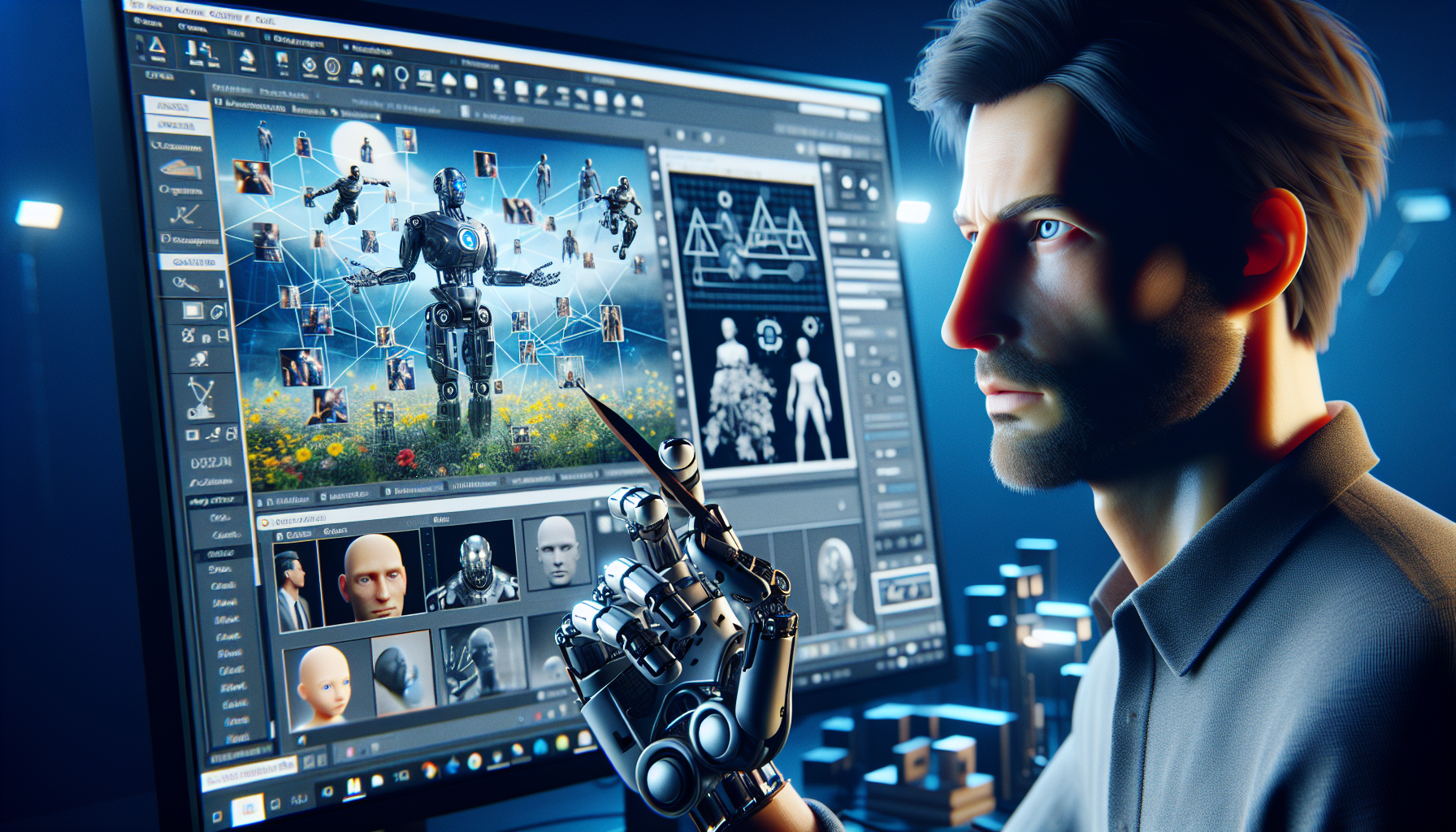
여기까지 적고 게시하면서 featured image를 고르는 단계에서 WP에게 쓸 이미지를 생성시켰다. 호. 글의 내용을 제법 알아 보고 이미지를 만들어 주었다. 이것 써 보자.